Robotic Sanding for High-Volume Production Shops
There's a difference between a robot that can sand and a robot built to sand all day, every day, shift after shift, in a dusty woodworking environment.
That difference is industrial-grade. Stolbek uses Yaskawa industrial robots - the same category of robotic technology used in automotive manufacturing, aerospace, and heavy industry.
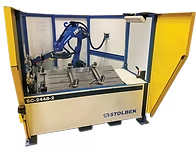
Industrial Robots vs. Collaborative Robots
Collaborative robots are designed to work alongside humans in shared workspaces. They're lighter, slower, and limited in payload and force. For sanding - where consistent force, precise pressure, and continuous operation matter more than anything else, industrial robots deliver better results.
| Specification | Industrial Robot | Collaborative Robot |
|---|---|---|
| Payload Capacity | 12 kg (GP12) | 3-5 kg typical |
| Cycle Speed | High - 2× faster than manual | Moderate - force-limited by design |
| Force Control | Precise, repeatable downward pressure | Force-limited for safety proximity |
| Duty Cycle | Continuous multi-shift production | Intermittent - some have duty cycle limits |
| Environmental Rating | IP67 - sealed against dust & moisture | Varies - often not rated for heavy dust |
| Delivery Model | Turnkey cell - no integrator needed | Requires system integrator + custom cell |
Some competitors sell cobot-based sanding kits that require system integrators to design and build the complete cell. Stolbek takes a different approach - the Yaskawa industrial robot comes inside a complete, turnkey sanding cell. No integrators. No custom engineering. No months of setup.
Why Yaskawa?
Yaskawa is one of the largest industrial robot manufacturers in the world with service infrastructure on every continent. For the full technical deep-dive, see the Yaskawa Robotics page.
Industrial Sanding Applications
Industrial-grade robotic sanding isn't limited to one type of shop. Any production environment running volume sanding benefits from the reliability, throughput, and consistency of an industrial system.
High-volume cabinet production
Shops running hundreds of doors per shift need a system that keeps pace without degradation. Industrial robots maintain the same cycle time on door 500 as on door 1.
Multi-shift operations
Shops running two or three shifts need equipment built for continuous duty. Industrial robots are designed for exactly this - cobots often have duty cycle limitations.
Furniture manufacturing lines
Larger parts, heavier panels, and more complex sanding paths require the payload and reach that industrial robots provide.
Contract manufacturing
Shops producing for multiple clients need consistent quality across every order. Automated inspection points in the sanding cell catch defects before parts move downstream.
Explore sanding automation by industry or browse specific sanding applications.
Stolbek's Industrial Sanding Systems
Cosmo robotic sanding cells already sand faces, edges, and break corners as standard. The Ultimate Edge Sander adds a dedicated edge-processing step for shops that want to separate edge work into its own high-speed production process.
Every Cosmo system uses Yaskawa industrial robots. The Ultimate Edge Sander complements any Cosmo system with PLC-driven edge sanding and corner breaking - industrial-grade consistency on a standalone machine.
See the full lineup including the Ultimate Edge Sander and Spin Bot on the Automated Sanding Systems page, or explore all products.
See Industrial-Grade Robotic Sanding in Your Shop
Not a simulation. Not a slide deck. The actual machine, sanding actual doors, in a live demo.