Panel Sanding Robot for Every Panel Type and Size
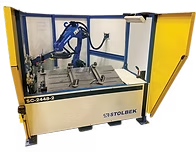
A panel sanding robot eliminates the variability that makes manual panel sanding so hard to staff and so hard to scale. If your shop sands panels - cabinet doors, drawer fronts, end panels, or furniture components - you already know the problem. Every panel style sands differently. Raised panels have contours. Slab panels need uniform pressure across a flat surface. Shaker doors have recessed centers with sharp inside corners. And your operators are trying to deliver consistent results across all of them, all day, while production waits.
A panel sanding robot delivers the same pressure, speed, and coverage on the first panel at 8 AM and the last panel at 4 PM. No fatigue. No variation. No bottleneck.
The Panel Sanding Challenge
Manual panel sanding is the constraint in most production workflows. Your CNC cuts parts fast. Your edgebander keeps pace. But sanding - especially on a high-mix production floor where door styles change throughout the day - is where everything slows down.
Different panel styles require different sanding approaches. A raised panel needs careful pressure around the contour. A slab door needs perfectly even coverage or the finish shows every imperfection. A 5-piece shaker door has transitions between rails, stiles, and the center panel that require attention at every joint.
Manual operators adjust their technique based on experience and feel. But experience varies between operators, feel changes with fatigue, and the door sanded at 3 PM rarely matches the one sanded at 9 AM. In high-volume production, that inconsistency shows up as rework, customer complaints, and lost time.
Stolbek Panel Sanding Solutions
Stolbek builds robotic sanding systems sized for different panel dimensions and production volumes. All of them are turnkey - no integrators, no custom engineering, no programming.
Cosmo SC
The system most shops start with. Uses a Yaskawa GP12 industrial robot with a work envelope of up to 26" × 108" - large enough for standard cabinet doors, drawer fronts, and end panels. Sands two times faster than a human operator. Footprint: 84"W × 101"D × 72"H.
Learn More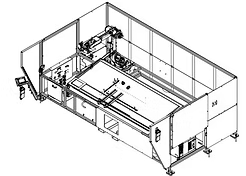
Cosmo Slide
The largest system in the lineup. Designed for shops running high-volume production on table tops, pantry doors, fridge gables, and large furniture panels. Edge and corner sanding included - even on the biggest parts.
Learn MorePanel Types We Sand
Raised panels
The robot follows the contour profile with consistent pressure, eliminating the over-sanding and burn-through that happens with fatigued manual operators.
Slab panels
Perfectly uniform coverage across the entire flat surface. No light spots, no heavy spots, no visible sanding marks under finish.
Shaker doors
Flat frame with recessed center panel. The robot handles the transitions between rails, stiles, and center panel without the operator needing to adjust technique.
5-piece doors
Rails, stiles, and center panel sanded as a complete unit. The robot adjusts to the part geometry automatically.
MDF, solid wood, and primer doors
Consistent pressure prevents burn-through on MDF and primer surfaces and delivers clean results on solid wood. For dedicated edge sanding, the Ultimate Edge Sander runs three grits in series with corner break in under 30 seconds per door.
Materials
Why Shops Switch to Robotic Panel Sanding
The sanding bottleneck disappears. Production is no longer scheduled around who showed up today. The machine runs whether you're fully staffed or short-handed.
Quality becomes predictable. Same finish, every panel, every shift. No more rework from inconsistent hand sanding. No more calls from clients about finish quality variation between batches.
Staff moves to higher-value work. Nobody wants to sand panels all day. But assembly, finishing, CNC operation, and inspection - those are careers. Shops that automate sanding report better employee retention because the worst job in the building no longer exists.
You stop thinking about sanding. That's the real win. One less fire. One less headache. The machine just runs.
See how a panel sanding robot fits your production, learn how the math works for your specific shop with the ROI Calculator, see the full business case at Why Automate Sanding, or read how kitchen and closet manufacturers apply panel sanding across high-mix production runs.
Explore more: ROI Calculator · Why Automate Sanding · Robotic Sanding Guide
Related applications: Cabinet Door Sanding · MDF, Solid Wood & Primer Sanding · Spray Finishing
See robotic panel sanding in action
Every shop is different. The right system depends on your parts, your volume, and your production goals. 15 minutes with our team and we'll tell you exactly which system fits - and which doesn't.