How Robotic Sanding Works in a Woodworking Shop
Robotic sanding is the use of programmable, industrial-grade robotic arms to automate the surface preparation of wood panels, cabinet doors, furniture components, and other woodworking parts. The global woodworking machinery market is valued at over $4.5 billion in 2026 and growing at nearly 7% annually, driven largely by labor shortages that have made sanding departments the single most difficult station to staff in modern cabinet and furniture shops.
This guide covers everything a woodworking shop owner needs to know before investing in a robotic sanding system - from how the technology works and what it costs, to how to evaluate different systems and calculate your return on investment. Ready to compare specific machines? See the Stolbek robotic sander lineup.
Why Sanding Is the Biggest Problem in Your Shop
Your CNC runs all day. Your edgebander keeps pace. Your assembly team is productive. But the sanding department? That's where everything slows down. It's the station with the highest turnover, the most workers' comp claims, and the most inconsistent output.
1. Labor Shortages Hit Sanding First
The woodworking industry employed roughly 214,600 workers in the US in 2024, according to the Bureau of Labor Statistics. Finding workers willing to sand all day is the hardest recruiting challenge in the trade. The job is repetitive, dusty, and physically demanding. When shops do find someone, turnover is measured in months, not years. Every departure triggers a $3,000 to $5,000 cost in recruiting, training, and lost production. Read more about the woodworking labor shortage, see the sourced woodworking automation statistics, or compare robotic sander vs wide belt sander.
2. Inconsistent Quality Compounds the Problem
Manual sanding quality depends entirely on who is doing it and when. Your best sander at 8:00 AM produces different results than your average sander at 3:00 PM. Fatigue, pressure variation, angle differences, and simple human inconsistency mean that two doors sanded by different operators will not match. In shops that track it, manual sanding rework rates typically run 5 to 10% of output.
3. Ergonomic Injuries Are a Hidden Cost
Repetitive strain injuries, carpal tunnel syndrome, and chronic dust exposure are occupational hazards of manual sanding. Workers' compensation claims, sick days, and the liability risk of running a sanding station that is actively harming employees all add real cost that many shops do not track.
4. The Bottleneck Blocks Growth
When your sanding department can only process as many doors as your operators can physically sand, growth is capped by headcount. This is the core reason shops turn to robotic sanding: not to replace workers, but to break the production ceiling that manual sanding creates. Learn more about why shops automate sanding.
How a Robotic Sanding System Works
A robotic sanding cell is designed so that anyone in your shop can operate it. No programming. No G-code. No CAD files. No barcode scanning. Learn more on How It Works.
Load the Part
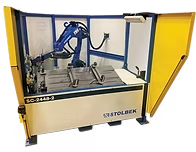
The operator places a cabinet door, panel, or component onto the vacuum table. Most turnkey systems use vacuum pod fixtures that hold the part securely without clamps. The Cosmo SC uses 6 vacuum pods on lineal guides that automatically adjust to part size.
Select the Recipe
On the touchscreen, the operator selects a saved sanding recipe - which defines the grit sequence, pressure, speed, and path for that part type. Recipes can be saved and recalled with one touch, so switching between shaker doors, slab doors, and raised panels takes seconds.
The Robot Sands - Faces, Edges, and Corners
The Yaskawa GP12 robot arm moves across the part using a multi-head end-of-arm tool: a 5" orbital disc for face sanding, a 3" × 5" orbital pad for detail work, and a 2" corner breaking head. It sands the face, runs the edges, and breaks the corners - all in one automated cycle. Consistent pressure on every pass. No fatigue. No variation.
Unload and Inspect
The operator removes the finished part, does a quick visual inspection, and loads the next piece. The entire cycle takes 30 to 90 seconds per door depending on size, profile complexity, and grit sequence. A single operator running one cell matches the output of 2 to 3 manual sanders.
Watch the Cosmo SC sand faces, edges, and corners in one automated cycle.
Types of Robotic Sanding Systems
Not all robotic sanding systems are the same. Understanding these categories is critical before evaluating specific products. Explore all products, or see the full automated sanding systems overview.
Turnkey Robotic Sanding Cells
A complete, self-contained sanding station that arrives ready to produce parts. Includes the robot, sanding heads, fixtures, dust extraction, touchscreen controls, and enclosure - all pre-engineered to work together. The key question: does it sand edges and break corners, or only faces? Stolbek's Cosmo SC handles edges, corners, and faces in a single cycle.
Cobot Sanding Kits
Collaborative robots equipped with sanding end-of-arm tools. Flexible but require a system integrator for cell design, programming, and commissioning. General-purpose by design - not purpose-built for woodworking. See Industrial Sanding Solutions for the full industrial vs. cobot breakdown.
Gantry-Mounted Systems
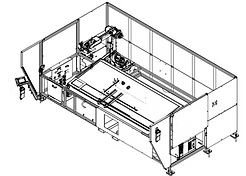
Robot mounted on an overhead track for a much larger working envelope. The only option for shops sanding parts larger than ~48" in either dimension. Stolbek's Cosmo Slide uses a gantry-mounted Yaskawa robot for parts up to 48"x120".
Traditional Brush Sanders
Spinning brush rollers for flat surfaces. Fast for flat panel sanding but cannot handle profiled doors, cannot sand edges, and cannot break corners. Effective for high-volume flat panel operations but lack flexibility for mixed door styles.
| Feature | Turnkey Cell | Cobot Kit | Gantry | Brush Sander |
|---|---|---|---|---|
| Sands faces | Yes | Yes | Yes | Yes |
| Sands edges | Some systems | Rarely | Some systems | No |
| Breaks corners | Some systems | No | Some systems | No |
| Handles profiled doors | Yes | Varies | Yes | No |
| Requires integrator | No (if truly turnkey) | Usually yes | Varies | No |
| Programming required | None to minimal | Yes (path programming) | Varies | None |
| Typical setup time | Days | Weeks to months | Days to weeks | Hours |
| Best for | Cabinet shops, mixed production | Flexible multi-task environments | Large panels, oversized parts | High-volume flat panels only |
The single most important capability to verify is edge sanding. If the system cannot sand edges and break corners automatically, you will still need dedicated manual sanding labor.
Stolbek Product Lineup
Cosmo SC
Turnkey robotic sanding cell for cabinet doors and panels. Sands faces, edges, and breaks corners in one cycle.
Best for:
Cabinet doors, standard panels, up to several hundred parts/day
Cosmo Slide
Highest-capacity system for demanding production. Table tops, pantry doors, fridge gables - no panel too big.
Best for:
High-volume production, table tops, pantry doors, large furniture panels
Ultimate Edge Sander
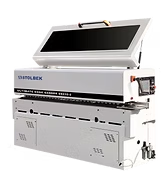
3-grit edge sanding and corner breaking in a single 30-second pass. PLC-driven reliability for MDF, solid wood, and primer doors.
Best for:
MDF, solid wood & primer doors, dedicated edge sanding, complement to any Cosmo system
Spin Bot
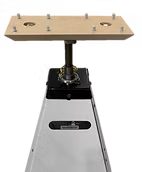
100% pneumatic spray booth turntable. No electricity needed. Pairs naturally with the Ultimate Edge Sander for edge-sand-then-spray workflow.
Best for:
Spray booths, finishing stations, sanding-to-finishing automation
What Can a Robotic Sander Handle?
Door Styles
All common cabinet door profiles - shaker, raised panel, slab, cathedral arch, and multi-panel configurations. The system recognizes different profiles and adjusts its sanding path accordingly through operator-selected recipes. See cabinet door sanding applications.
Materials
Hardwood (maple, oak, cherry, walnut), softwood (pine, poplar), MDF, HDF, paint-grade primer, veneer, and composites. The Ultimate Edge Sander is specifically designed for MDF, solid wood, and primer doors.
Part Sizes
Standard cells handle parts from small drawer fronts up to approximately 48×48 inches. Gantry-mounted systems extend that range to oversized panels - table tops, pantry doors, fridge gables exceeding 60 inches. See panel sanding applications.
Finishing Stages
Raw wood preparation (removing machine marks, leveling grain), between-coat sanding (smoothing primer or sealer before topcoat), and final preparation before staining or lacquering. Different stages require different grit sequences and pressure settings - all manageable through saved recipes.
Industries That Benefit Most
Robotic sanding applies to any woodworking operation where manual sanding creates a bottleneck. Four industries see the fastest ROI. Explore sanding automation by industry, including our guide to robotic sanding for cabinet shops.
Cabinet manufacturers - the most common buyers - sanding is their #1 turnover position.
Furniture manufacturers - growth blocked by manual sanding throughput.
Millwork & door manufacturers - consistent finish across dozens of door styles.
Kitchen & closet producers - volume demands exceed manual capacity, especially on MDF, solid wood, and primer doors.
Sanding Applications
Explore specific sanding applications. Browse all applications.
Panel Sanding - robotic sanding for raised, slab, shaker, and recessed panels.
Cabinet Door Sanding - automate the #1 bottleneck in cabinet shops.
MDF, Solid Wood & Primer Sanding - 3-grit edge sanding and corner breaking in under 30 seconds.
Spray Finishing - pneumatic turntable for consistent spray booth rotation.
The Cost of Robotic Sanding - and the Cost of Not Automating
Most shops underestimate their current sanding costs because they track labor hours but not the full loaded cost. Here's a realistic breakdown:
A robotic sanding system typically allows one operator to replace the output of 2 to 3 manual sanders. Quality becomes predictable - shops commonly report going from 5 to 10% rework to under 1%. Production is no longer capped by who showed up today.
Most shops see a payback period of 12 to 18 months through combined labor savings, turnover elimination, and rework reduction. Use the ROI Calculator to model your specific numbers, read the robotic sanding ROI guide, or see Why Automate Sanding for the full business case.
Machine price is only one part of the decision. Our robotic sanding machine cost guide explains the factors that affect system pricing, installation, training, financing, and total cost of ownership.
How to Choose a Robotic Sanding System
Not every system will be right for your shop. Here's a practical evaluation framework - green flags to look for and red flags to avoid. For a detailed comparison checklist, see Top Questions to Ask When Buying a Sanding Machine.
✓ Green Flags
Can it sand edges AND faces?
If the system only sands faces, you still need someone manually sanding every edge and breaking every corner. That significantly reduces your labor savings. Ask explicitly: does this system handle edges, corner breaks, and faces in one automated cycle?
Is it truly turnkey?
"Turnkey" means you plug it in, load doors, and start producing. No integrators. No custom engineering. No months of programming. If the vendor mentions needing a system integrator or extended commissioning - it is not turnkey, regardless of what the brochure says.
Was it built for woodworking?
A company that came from the woodworking industry understands your production challenges firsthand. They know the difference between sanding maple and MDF, they understand shaker door profiles, and they have designed recipes around real woodworking applications.
Does it use industrial-grade robots?
Yaskawa, FANUC, KUKA, and ABB are the major industrial robot manufacturers with proven track records in continuous industrial operation. Ask what robot platform the system uses.
Can one operator run it?
The whole point of automation is reducing labor dependency. If the system needs two operators, a programmer, or a technician on standby, the labor savings math changes significantly.
Is there a complete product ecosystem?
The best automation partner offers not just the sanding cell, but complementary products - edge sanders, spray equipment, consumables, and replacement parts - so you have one relationship managing your entire sanding and finishing workflow.
✕ Red Flags
"You'll need a system integrator."
This means the product is a component, not a solution. Integrators add $50,000 to $150,000+ in cost, 3 to 6 months of timeline, and a layer of complexity between you and the manufacturer.
"It requires programming."
Modern turnkey sanding systems do not require G-code, CAD files, or robot programming. If the vendor mentions programming as part of ongoing operation, the system is not designed for a woodworking shop environment.
"Edges must be sanded manually."
If you hear this, the system is not a complete sanding solution. You will still need manual sanders, and your labor savings will be 40 to 60% of what a full edge-to-face system delivers.
Long lead times for custom engineering.
Some vendors build every system as a custom project - months of engineering, higher costs, and less standardized support. Purpose-built, standardized systems ship faster and are better supported.
No woodworking references.
If the vendor cannot provide references from cabinet shops or furniture manufacturers running their system in production, proceed carefully. A demo cell is very different from a system that has survived 12 months of daily production.
Common Myths About Robotic Sanding
Myth: "Robotic sanding is too complicated for my shop"
Reality: Modern turnkey sanding systems are designed for woodworkers, not engineers. No programming, no G-code, no CAD files. Operation is as simple as selecting a recipe on a touchscreen and pressing start. QR codes on the machine link to video guides. If your operators can run a CNC router, they can run a robotic sanding cell.
Myth: "Robotic sanding is only for big factories"
Reality: Robotic sanding cells are available for shops producing as few as 50 to 100 doors per day. The investment makes financial sense for any shop where sanding labor costs exceed the monthly cost of owning the machine - which for most shops is a surprisingly low threshold.
Myth: "A robot can't sand edges"
Reality: Partially true - for most systems. The majority of robotic sanding machines are designed for face sanding only. However, some systems are specifically engineered to sand edges, break corners, and handle face sanding in a single automated cycle. The difference is between reducing sanding labor by half and nearly eliminating it.
Myth: "Setup takes months"
Reality: Custom-engineered systems can take months. Purpose-built, turnkey sanding cells are standardized products that ship ready to produce parts. Installation and training typically take days, not months. Most shops are sanding production parts within the first week.
Myth: "The robot will replace all my workers"
Reality: Robotic sanding does not eliminate your workforce - it redeploys them. One operator still loads parts. The 2 to 3 people who were previously palm sanding move to assembly, finishing, or quality control - work that is more engaging and more likely to retain employees.
Myth: "I can't justify the investment"
Reality: Run the numbers. If your sanding department costs $8,000 to $10,000 per month in labor alone - before rework, turnover, workers' comp, and opportunity cost - the math often shows a 12 to 18 month payback. After that, every month is pure savings.
The Technology Behind Robotic Sanding
Industrial Robots
The robotic arm is the core of any sanding system. Stolbek uses the Yaskawa GP12 - a six-axis arm with 12 kg payload and 1440 mm reach, purpose-built for the force requirements of cabinet door sanding. Yaskawa, FANUC, KUKA, and ABB are the major manufacturers with proven continuous-operation track records.
Force Control
Consistent sanding requires consistent contact pressure. Too much creates burn marks; too little leaves scratch patterns. Force control technology maintains precise, programmable contact force regardless of surface variation - if the part has a slight bow, a raised grain area, or a profile transition, the controller adjusts in real time.
End-of-Arm Tooling (EOAT)
The sanding head that actually contacts the wood. The Cosmo SC's EOAT includes a 5" orbital disc for face sanding, a 3" × 4" orbital pad for detail work, and a 2" corner breaking head. The multi-head design sands faces, edges, and corners without tool changes.
Dust Extraction
Fine wood dust must be captured for both air quality and finish quality. Robotic sanding cells include integrated dust extraction - through-tool vacuum, enclosure-based collection, or both. Effective extraction protects the finish, extends abrasive life, and maintains a cleaner work environment.
Robotic vs. Manual Sanding
For shops weighing the decision, here's a direct comparison across the factors that matter most. For a deeper breakdown, see see the full comparison.
| Factor | Manual Sanding | Robotic Sanding |
|---|---|---|
| Quality consistency | Varies by operator and time of day | Identical on every part, every cycle |
| Throughput | Limited by human endurance and speed | 400+ doors/day possible per cell |
| Labor requirement | 2 to 3 operators per station | 1 operator per cell |
| Edge sanding | Yes (manual by default) | Depends on system - some yes, many no |
| Corner breaking | Yes (manual by default) | Depends on system - some yes, many no |
| Training time | 2 to 4 weeks for competent sanding | Hours to days for cell operation |
| Turnover risk | High - least desirable job | Low - operator role is less demanding |
| Rework rate | 5 to 10% typical | Under 1% typical |
| Ergonomic risk | High (RSI, dust, vibration) | Minimal (load/unload only) |
| Scalability | Hire more people (if you can find them) | Add shifts or additional cells |
| Cost per door | Higher and rising with wages | Lower and fixed after payback |
The only area where manual sanding has an inherent advantage is edge work - but only for robotic systems that cannot handle those operations. Systems that include edge and corner capability eliminate even that advantage.
Why Edge Sanding Changes Everything
Most robotic sanding systems do one thing well: sand flat faces. If your robot sands the face but your operators still manually sand every edge and break every corner, you haven't eliminated the sanding department - you've just made it smaller.
Stolbek is the only robotic sanding system that handles edges, corners, AND faces in one cell. The Cosmo SC's end-of-arm tool includes a dedicated 2" corner breaking head. The Ultimate Edge Sander takes it further with three grits in series - processing a door in under 30 seconds.
When you eliminate manual orbital edge sanding, you eliminate the last orbital sanding operation in the shop. Read the full breakdown at complete edge sanding guide, or see The Edge Sanding Advantage.
Frequently Asked Questions
Ready to See Robotic Sanding in Action?
Every shop is different. The fastest way to get answers specific to your operation is a 15-minute conversation with someone who has been in your shoes.
For a complete list of sanding automation terminology, see the Sanding Automation Glossary.