The Edge Sanding Advantage
By Brad Cairns, Owner of Stolbek
When evaluating robotic sanding systems, there's one question that separates real automation from partial automation: Does it sand edges and break corners?
If the answer is no, you're still going to need someone standing at that machine doing the work by hand. That's not automation - that's a compromise.
"If your goal is simply robotic sanding, there are many options. If your goal is flow, throughput, and quality at the source, the conversation changes."
Most "Robotic Sanders" Leave the Hardest Part to You
The majority of robotic sanding systems on the market today were designed for flat surfaces only. They'll sand the face of a panel beautifully - but edges, corners, and profiles? That's still on your operators.
This creates a deceptive situation: you've invested in automation, but your labor costs haven't dropped as much as projected because you still need sanders stationed at the machine to finish what the robot can't.
Learn more about why shops are automating their sanding and what to look for in a real solution, or read The Complete Guide to Robotic Sanding.
Why Complete Surface Sanding Changes Everything
Complete Automation, Not Partial
Most robotic sanding systems only sand flat faces. That means operators still have to manually sand every edge and break every corner by hand - after the robot finishes. You've automated 70% of the job and created a new bottleneck for the other 30%.
Consistent Edge Quality
Hand-sanded edges vary from operator to operator, shift to shift. Automated edge sanding delivers the same consistent radius and finish on every single part - eliminating the rework that inconsistent edges cause downstream in finishing.
Fewer Touches, Faster Throughput
When one machine handles faces, edges, and corners in a single cycle, you eliminate part handling between stations. Fewer touches means less chance of damage, fewer operators needed, and faster cycle times.
The Corner Break Matters
Unbroken or inconsistently broken corners lead to finish failures - paint doesn't adhere, stain pools, and lacquer chips. A consistent corner break is the foundation of a quality finish. Stolbek machines deliver it automatically on every part.
See the edge sanding advantage in action: Cosmo SC robotic sanding cell delivers faces, edges, and corners in one cycle. For dedicated edge work, the Ultimate Edge Sander handles high-volume edge finishing at production speed.
How Edge Sanding and Corner Breaking Work
Edge sanding isn't just running sandpaper along the side of a door. It's a precision operation that determines how the finish looks, how the paint adheres, and whether the door feels finished or rough to the touch.
Edge sanding removes machining marks, saw blade patterns, and surface irregularities from the edges of a door or panel. On MDF, it smooths the dense, fibrous edge that's notoriously difficult to finish cleanly. On hardwood, it evens out the end grain and side grain transitions.
Corner breaking removes the sharp 90-degree edge where the face meets the side of the door. Without a corner break, paint and primer pool at the sharp edge, crack during handling, and chip in transit. A consistent corner break - the same radius on every door, every edge - creates a smooth transition that holds finish and looks professional.
In a manual operation, both of these depend entirely on the operator's hands. Pressure varies. Angle varies. The radius of the corner break varies from one end of the door to the other. Multiply that by hundreds of doors per shift and the quality inconsistency becomes a production problem.
Built on Proven Manufacturing Principles
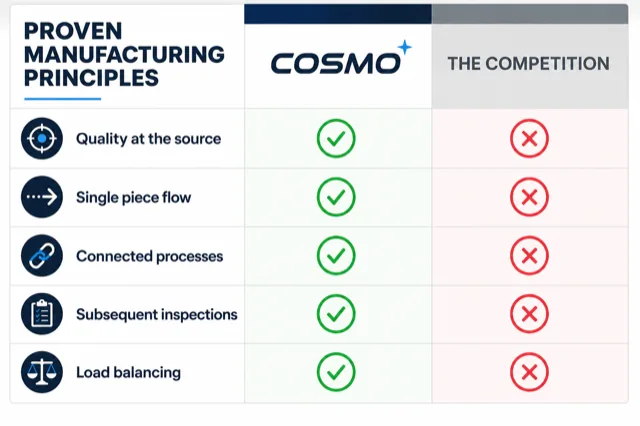
There are many ways to automate sanding. We chose to build a system around proven manufacturing principles: flow, connected processes, load balancing, and quality at the source. That changes everything downstream.
Hover any highlighted term for a quick definition. Also see subsequent inspection, the discipline that keeps every step honest.
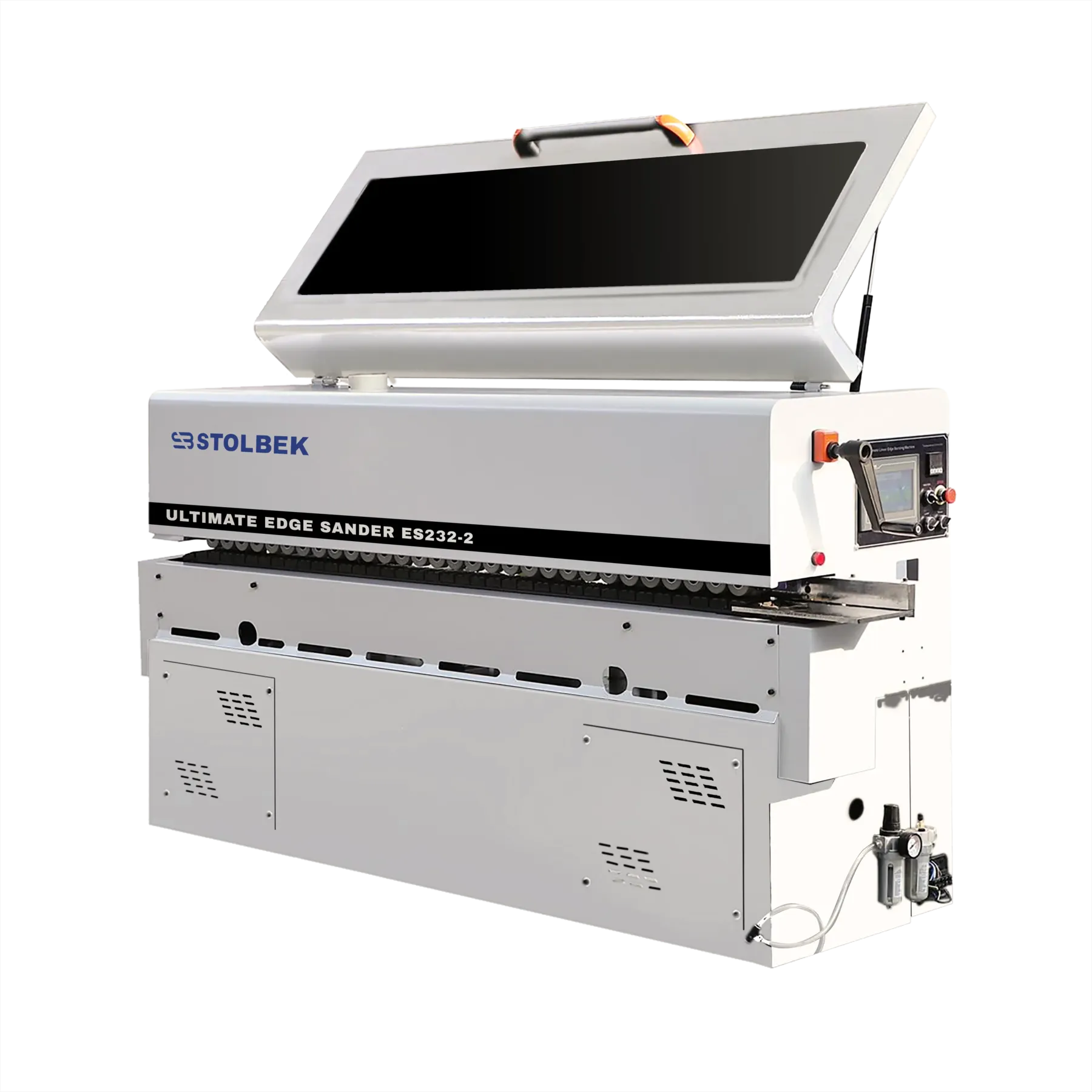
The Ultimate Edge Sander for Dedicated Edge Processing
For shops that need dedicated edge sanding capacity - especially on MDF, solid wood, and primer doors - the Ultimate Edge Sander ES232-2 is purpose-built for the job.
3 Grits in Series
Three 5" orbital sanding heads run coarse, medium, and fine grit in a single pass. No running the part through multiple times. One pass, three grits, done.
Simultaneous Corner Breaking
Two dedicated 2" orbital sanding heads handle corner breaking at the same time the edges are being sanded. A high-frequency spindle handles corner breaking and small profiles. Every door gets the same consistent corner radius.
Under 30 Seconds Per Door
Profile, edge sand, and corner break. All completed in under 30 seconds. Dual feed speeds of 27 ft/min and 46 ft/min let you match throughput to production demand.
Power
220V 3-phase at 15 FLA
Air
60 CFM at 80 PSI (1" diameter supply line)
Dust Extraction
4" duct connection
Footprint
90" L × 24" D × 49" H
Min Part Width
2"
Max Edge Thickness
1-3/4"
Materials
MDF, wood, solid surface, primer
Control
PLC with touchscreen HMI
The machine handles multiple parts at a time and sands primer too, not just raw material. Replacement parts and consumables are available through the Supplies portal.
Materials and Applications
MDF
The most common application. MDF edges are dense, fibrous, and absorb primer unevenly if not sanded properly. Delivers smooth, consistent edges ready for primer and topcoat. Learn more →
HDF
Denser than MDF, same sanding requirements. Consistent edge preparation for paint-grade finishing.
Primer-Coated Doors
Sands primer without breaking through or creating uneven surfaces. Critical for doors that arrive pre-primed from the panel supplier.
Paint-Grade Panels
Delivers a surface ready for topcoat application. No hand touch-up needed after the machine.
Hardwood
Adjustable pressure settings handle different wood species. Oak, maple, cherry, walnut. The machine adapts to the material.
Veneer Panels
Gentle enough for veneer without sand-through. Pressure control prevents damage to thin face layers.
Solid Surface
Handles composite materials beyond wood, including solid surface countertop edges.
See all cabinet door sanding, panel sanding, and spray finishing applications.
Edge Sanding in a Complete Production Workflow
Edge sanding is one step in a larger door finishing process. Stolbek's product lineup creates a complete workflow with no manual orbital sanding at any stage:
Three machines. Zero manual sanding. Raw to finish-ready without a single operator picking up a palm sander.
What Other Systems Cannot Do
Most robotic sanding systems on the market sand flat faces. That's useful, but it's not complete automation.
If the robot sands the face but your operators still manually sand every edge and break every corner by hand, you haven't eliminated the sanding department. You've made it smaller. You still need dedicated edge sanding labor. You still have quality variation from operator to operator on those edges. And you still have the staffing problem on the position nobody wants.
Stolbek is the only robotic sanding system manufacturer that eliminates manual edge sanding entirely. The Cosmo SC's end-of-arm tool includes a dedicated 2" corner breaking head. The Ultimate Edge Sander processes edges and corners in a single automated pass. For the full process breakdown, read the edge sanding guide. Together, they handle every sanding operation - faces, edges, and corners - without a human operator picking up sandpaper.
That's the difference between partial automation and full automation. And it's the single most important question to ask any sanding robot vendor: "Can your system sand edges and break corners, or do my people still do that by hand?" See what to look for when comparing systems. For shops evaluating industrial-grade sanding solutions, edge capability is non-negotiable.
For shops focused specifically on edge sanding and corner breaking, Stolbek's automatic edge sander provides a dedicated production solution.
Frequently Asked Questions
Stop Compromising on Edge Quality
See the only robotic sanding system that handles faces, edges, and corners - all in one automated cycle.
Calculate your ROI to see the payback timeline for your shop.
"Anyone can automate movement. The challenge is improving the factory."